01 Opportunity
More and more smart field devices — sensors, meters, IO-Link masters — now publish their data over a modern web interface (a REST/JSON API), the same kind of language that powers websites and apps. It’s a clean, future-friendly way to get rich information out of a device. The catch is that it doesn’t look like the traditional industrial signals a plant’s SCADA system expects.
The goal was straightforward to state and harder to deliver: take the live data from one of these modern devices and make it appear inside Siemens WinCC Unified — the plant’s HMI and SCADA platform — continuously, in the background, no matter what screen an operator happens to be on, and in a form a business system such as an ERP or MES can simply read.
02 Solution
The HMI platform is deliberately locked down — for good security reasons, it won’t reach out to the wider network on its own. So rather than fight that, we followed Siemens’ own recommended pattern: a small, purpose-built companion program that runs quietly alongside WinCC Unified, talks to the device, and hands the results into the HMI through Siemens’ supported interface.
That companion does three things, cleanly and repeatedly: it reads the live data from the device over a secure, encrypted, authenticated connection; it turns the raw figures into real engineering values an operator would recognise; and it writes those values into WinCC Unified. Because it runs as its own background process, the feed never stops when the operator changes screens, and it picks itself back up automatically if the connection drops.
Security was treated as a first-class requirement, not an afterthought. The link to the device is properly encrypted and authenticated — we explicitly avoided the common shortcut of switching security checks off to “just make it work”, which would have left the connection open to tampering.
03 Outcome
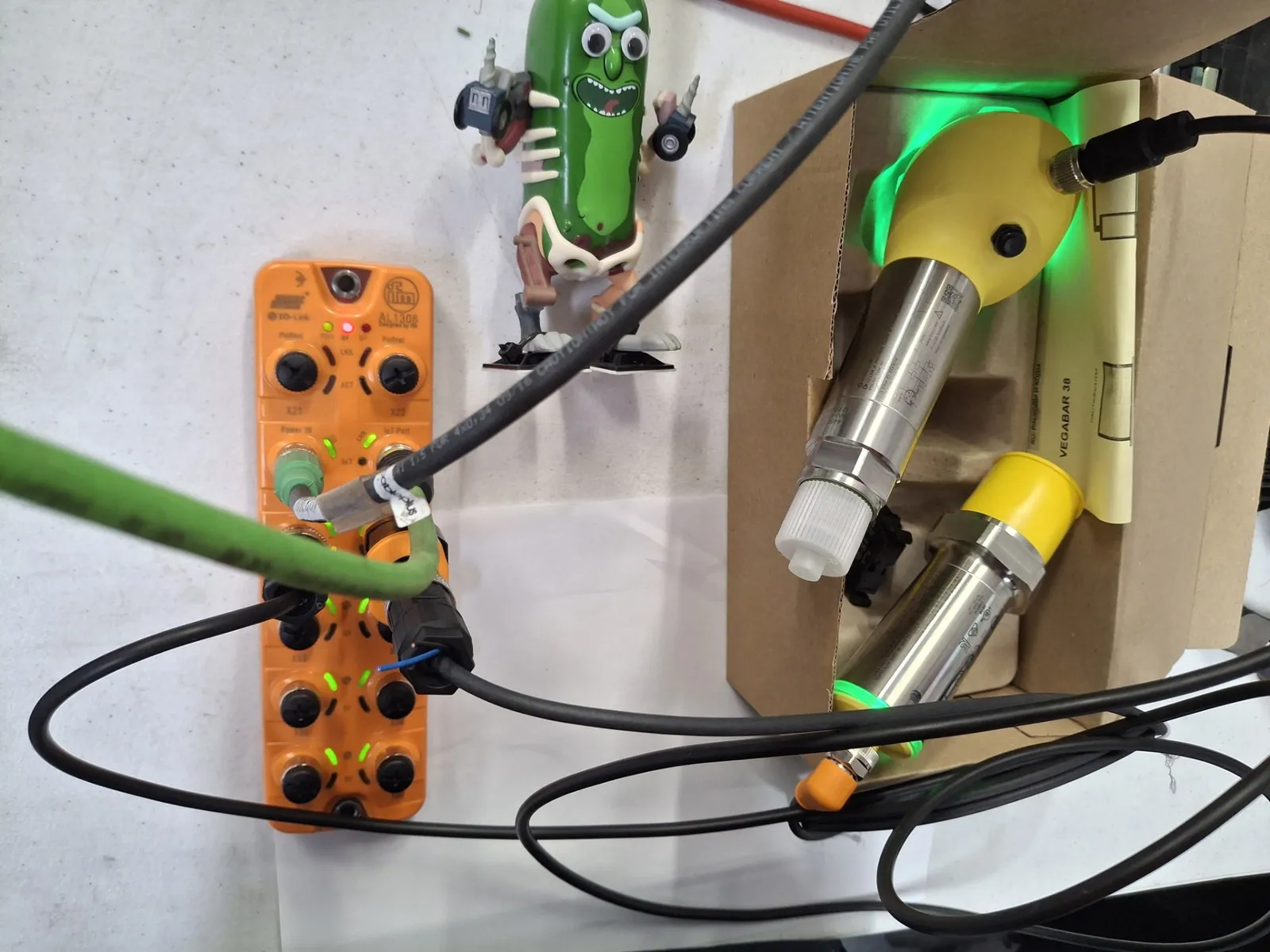
It works — proven live, end to end, on real hardware. Live readings from the smart sensor flow continuously into WinCC Unified over a secure, authenticated link, matching the values shown on the device itself. From there the data behaves like any other process value on the system: an operator screen can display it, and an ERP or MES can read it for reporting, stock, quality or maintenance — without anyone touching the HMI.
Just as importantly, the approach is repeatable. The same pattern — read a modern web API, make sense of the data, deliver it into WinCC Unified — extends to other REST/JSON devices and other plant data. It turns a class of modern smart devices that used to sit outside the SCADA world into a first-class source of live, business-ready information.
04 Project highlights
- Live readings from a modern REST/JSON smart sensor land directly in WinCC Unified
- Runs continuously in the background — the feed keeps flowing no matter what screen an operator is viewing
- Secure by design: encrypted, authenticated access to the device, not a security shortcut
- Self-recovering: rides through dropped connections and can run as an always-on service
- Uses Siemens’ own recommended integration pattern — not a fragile workaround
- Once in WinCC Unified, the data reads like any other process value for ERP, MES or an operator screen